Description
A grafted apple tree is a single plant created by joining two distinct parts: the scion (a shoot from a desired apple variety) and the rootstock (the root system of another apple tree). As the graft heals, the two parts unite and function as one tree, but each maintains its own genetic identity. This method is the standard for commercial and home apple production, as it is the only reliable way to produce a tree that is genetically identical to a specific, named cultivar, rather than the unpredictable results of growing from seed.
Detailed Description:
-
Size:
The mature size of a grafted apple tree is primarily determined by the rootstock, not the scion variety. Rootstocks are classified by their dwarfing effect on the scion:-
Dwarfing: Produces a tree that is 8–10 feet tall and wide. These are ideal for small gardens and containers and induce early fruiting.
-
Semi-Dwarfing: Produces a tree that is 12–15 feet tall and wide. This is a popular choice for home orchards, offering a manageable size and good yield.
-
Standard (Seedling): Produces a large tree that can reach 30 to 40 feet in height and spread. These are less common now due to the difficulty of harvesting and pruning.
-
-
Leaves:
The leaves are identical to those of the scion variety. They are simple, alternate, ovate to elliptic in shape, with serrated margins. -
Flowers:
Grafted trees are known for their precocity, meaning they begin to flower and bear fruit much earlier than trees grown from seed. A grafted apple tree typically produces fruit in 3 to 5 years, whereas a seedling tree may take over a decade. Most apple varieties are not self-fertile and require another, compatible variety for pollination. -
Fruit:
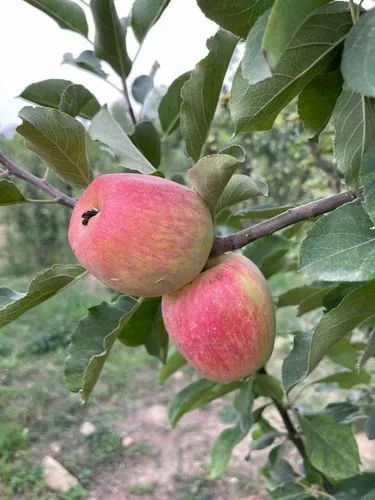
The fruit is the primary reason for grafting. It will be true-to-name, meaning it will be identical in every way to the parent scion variety—the size, shape, color, flavor, and texture are all predictable and consistent. -
Branchlets:
These are characteristic of the Malus domestica species, with young growth often being pubescent (covered in fine hairs). -
Bark:
The most distinctive feature of a grafted tree is the graft union, a visible bulge on the trunk a few inches above the ground. This is where the scion and rootstock have fused. On young trees, the graft union is clearly identifiable; in older trees, it may become less conspicuous.
Other Notable Features:
-
Reliable Propagation: Grafting is a form of cloning. Since every ‘McIntosh’ apple tree, for example, is grafted from a single original tree, all ‘McIntosh’ trees are genetically identical. This ensures that the fruit and tree characteristics are consistent and reliable.
-
Early Fruiting (Precocity): One of the greatest advantages of grafting is that the scion is taken from a mature tree, so the new tree will bear fruit much sooner than a seedling. Dwarfing rootstocks, in particular, encourage earlier flowering and fruiting.
-
Vigor Control: The rootstock is a powerful tool for managing the tree’s size and vigor. This allows for high-density planting, easier management, and improved fruit quality.
-
Hardiness and Adaptability: Different rootstocks are bred for specific traits, such as resistance to pests and diseases, or tolerance to different soil types and climates. The rootstock can be selected to match the local growing conditions, ensuring the grafted tree is resilient and productive.
-
Multi-Graft Trees: Some trees are grafted with multiple scions, allowing a single tree to produce several different apple varieties. This is an excellent space-saving solution for home gardens.
Reviews
There are no reviews yet.