
Description
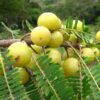
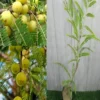
The amla plant, also known as the Indian gooseberry or by its scientific names Emblica officinalis and Phyllanthus emblica, is a small to medium-sized deciduous tree of the family Phyllanthaceae . Its native range extends across tropical and southern Asia, including Nepal, making it a well-suited and valuable plant for cultivation in the region . It is a handsome and hardy tree, notable for its distinctive appearance and highly valued fruit.
Detailed Description:
-
Size:
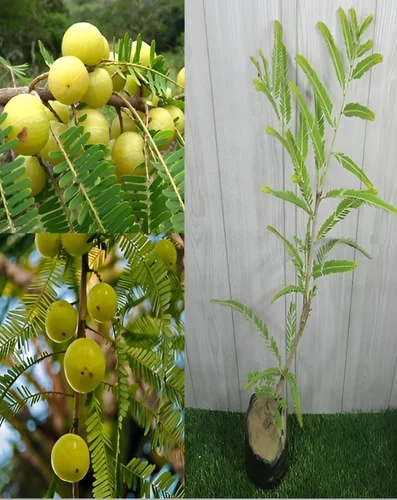
Amla trees are typically small to medium in size. While they generally reach heights between 1 and 8 meters, they can grow up to 18-23 meters tall under optimal conditions . The tree is rather slow-growing and often has a crooked trunk . -
Leaves:
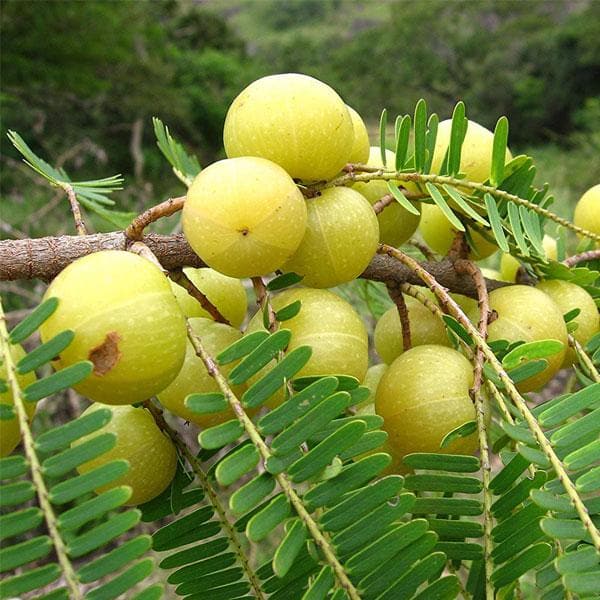
The leaves are simple and subsessile (short-stalked) . They are small, oblong, and closely arranged along the branchlets, giving the appearance of feathery, pinnate leaves . The leaves are light green, paler on the underside, and have a papery or leathery texture . They are often deciduous, falling along with the branchlets . -
Flowers:
Amla plants produce small, inconspicuous greenish-yellow flowers . These flowers are unisexual and grow in dense clusters along the branchlets, with male flowers typically appearing in the lower parts and female flowers above them . -
Fruit:
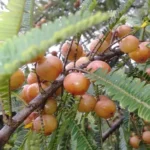
The fruit is the most notable feature of the tree. It is nearly spherical, smooth, and hard in appearance, with a light greenish-yellow color that turns whitish or dull greenish-yellow as it matures . A key identifying feature is the presence of six vertical stripes or furrows . The fruit has a sour, bitter, and astringent taste, with a fibrous, crisp, and juicy texture . The edible part is the fleshy mesocarp, which encases a hard stone containing small seeds . -
Branchlets:
The branchlets are not glabrous (hairless), often being finely pubescent (having fine hairs). They are characteristically deciduous and grow to a length of 10–20 cm, falling as a unit . -
Bark:
The bark is a distinguishing feature. It is a pale greyish-brown or greenish-grey and has a smooth texture, peeling off in thin, irregular flakes, similar to the bark of a guava tree .
Other Notable Features:
-
Hardiness: Amla plants are known for their impressive hardiness and tolerance. They can thrive in various soil conditions, including salinity and alkalinity, and are noted for being able to grow in regions too dry and soil too poor for most other fruit crops . They are also fire-resistant .
-
Climate: They are subtropical plants that prefer a dry subtropical climate . While they can tolerate high temperatures and frost to some extent, young plants may need protection from harsh conditions .
-
Culinary and Medicinal Uses: The fruits are highly versatile and are used in culinary applications such as pickles, preserves, chutneys, and eaten fresh or cooked . They are rich in Vitamin C and are a vital ingredient in many traditional Ayurvedic medicinal formulations, including the famous tonic Chyavanprash

Reviews
There are no reviews yet.